
Tree questions, answered plainly
Prices, what the city asks you to check, how Alabama treats a neighbor's branches, the southern pine beetle, and what actually makes a tree fail. Written for Vestavia Hills and Jefferson County.




Prices and what shifts them
With reasonable access, roughly $12 to $30 for every foot of height around this part of Jefferson County. A slope, a roof beneath it, or wood too far gone to climb all push toward the top. The smallest jobs sit on a minimum charge instead. Measured first, then written down.
Between $2 and $5 per inch of stump diameter, measured across the widest point at ground level, with a minimum for a single small stump. Oak and hickory grind slower than pine and sit at the upper end.
Because everything that sets the figure is invisible on a call. What is beneath it, whether anything can physically reach it, how sound the wood still is, and how much of it has to be lowered rather than dropped.
Not here. The same rate sheet applies in the week after a tornado warning as in a quiet February, and the scope goes on paper in a form an adjuster can read.
Before you hire in this city
Vestavia Hills tells residents to make sure a tree contractor holds a Vestavia Hills business license before work starts, and reminds you that the contractor, not the city, is responsible for hauling the tree and trimmings away.
In part. The Department of Agriculture and Industries issues a Tree Surgery permit under a horticulture professional services license. The published scope covers removing diseased parts, filling cavities, halting decay and bracing limbs.
We are not going to pretend to a tidy answer. The published scope reads as treatment and repair rather than felling, and the department is the right place to confirm it. Anyone doing cavity or bracing work should hold it.
The city states that Public Services generally does not remove healthy trees from the right of way, and asks residents to report dead or sick ones to the city rather than arranging removal themselves.
Neighbors and boundary trees
In Alabama, you do. The state follows the common-law rule: you may trim back to the property line at your own expense, without permission, but only the part physically on your side of it.
Yes. The cutting has to be reasonable and must not destroy the tree. Take too much and the liability can run back the other way, toward you, for the value of what you killed.
Then it is treated as jointly owned and neither owner can have it taken out alone. Getting that agreed in writing between neighbors beforehand saves a great deal of difficulty later.
No, and it catches people who have moved here. Louisiana, for instance, puts the cost of trimming encroaching branches on the tree's owner. Alabama puts it on the person whose garden they hang into.
Pine and the beetle
Popcorn-sized pitch tubes on the bark, reddish boring dust in the crevices and at the base, needles fading from green through yellow to red, and heavy woodpecker work on the trunk. Two of those together earns an inspection.
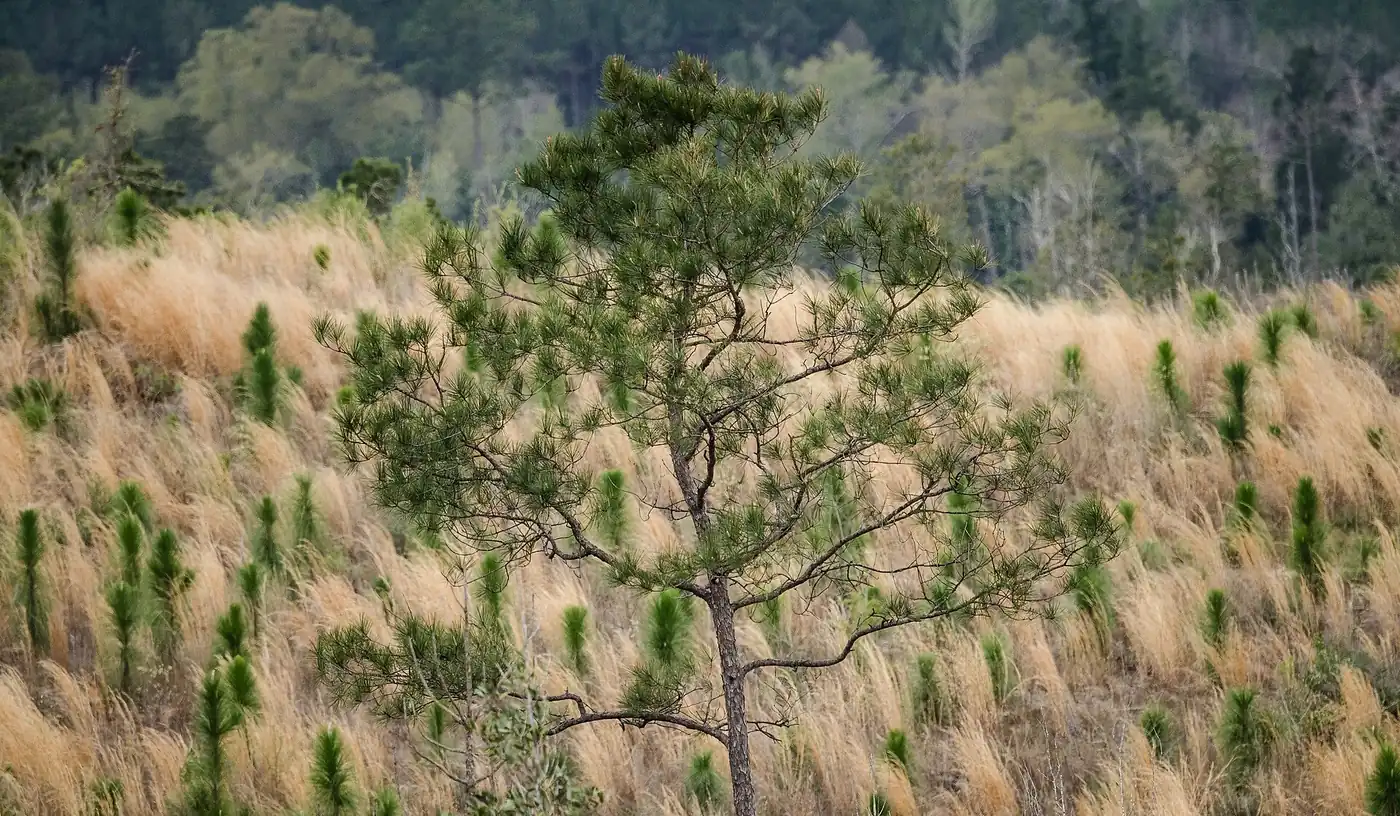
Loblolly and shortleaf mainly, along with Virginia, pond and pitch pine, and most of the trouble is in loblolly. It targets trees already stressed by drought, flooding, physical damage or overcrowding.
Not that applies here. The southern pine beetle is a native insect and an arboricultural problem rather than a regulated quarantine pest, which is a genuine difference from what some other states deal with.
Sooner is cheaper. Pine dries and goes brittle quickly, and brittle wood removes the option of climbing it, which moves the job to a lift or a crane and moves the price with it.
How trees fail and what to look at
It achieves the opposite. Topping is condemned under the A300 standard. It strips the foliage the tree feeds on and forces a mass of shoots attached only to the outer wood, which break sooner than the limbs removed.
Rot at the root flare, a hollow that has spread through the shell, splits opening at a fork, a crown that has lost most of its living foliage, and a root plate that has begun to lift. Then whether anything below is worth protecting.
Not on its own. Trees lean for all sorts of reasons and stay put for decades. What changes the answer is fresh movement at the base, which on a slope shows up earlier than it would on the flat.
Exposure. A crest lot has no shelter on either side, so it takes wind that streets in the valley barely register. The same tree is a different risk depending which side of the mountain it grew on.
Working Vestavia Hills and Jefferson County
The ridge and the valleys either side of it: Hoover and Bluff Park south, Homewood and Mountain Brook north, Birmingham beyond, and out to Pelham, Helena and Alabaster when the job is worth the run. One rate sheet, no mileage line.